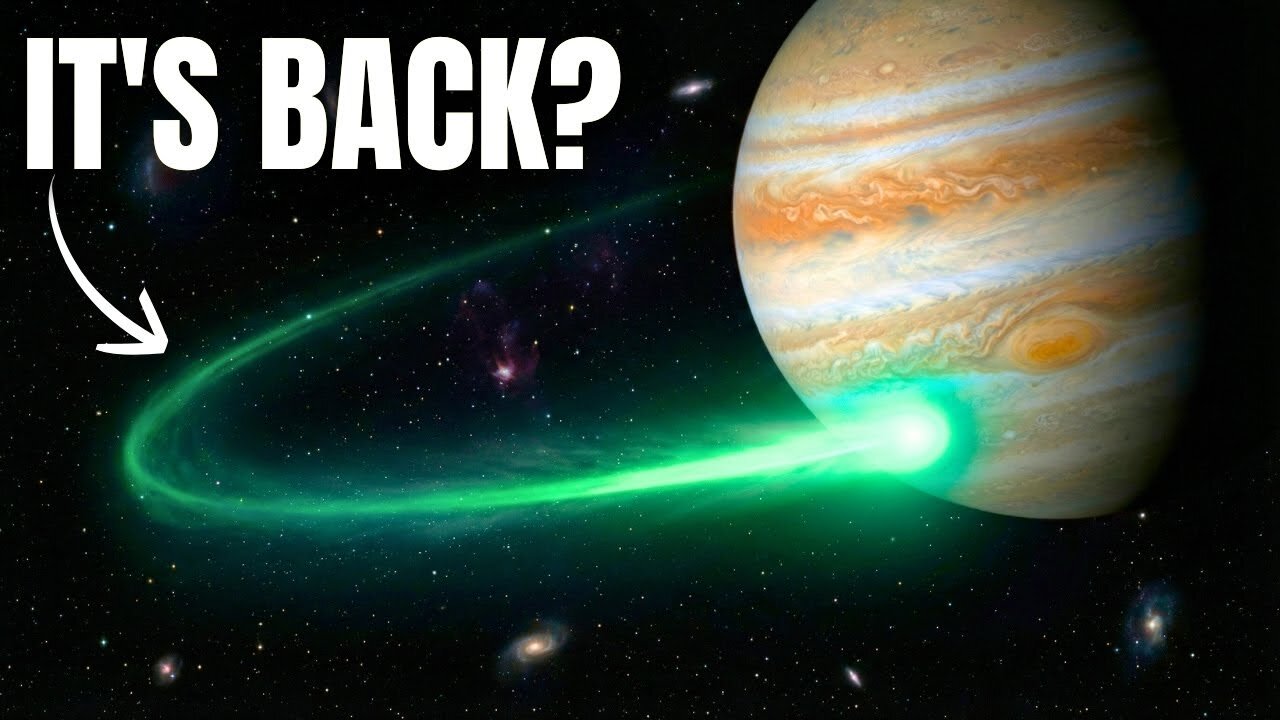
Why Jupiter Controls the Solar System Jupiter is enormous.
Why Jupiter Controls the Solar System
Jupiter is enormous.
More massive than
all other planets combined.
Its gravity is so strong
that it shapes the architecture
of the solar system.
Jupiter: The Gravity King
If the Sun is the ruler,
Jupiter is the enforcer.
Anything that enters
the outer solar system
must pass through Jupiter’s territory.
That includes:
• Comets from the Kuiper Belt
• Asteroids from the outer regions
• Interstellar objects passing through
Jupiter doesn’t need to touch an object
to change its fate.
Its gravity alone
is enough.
The Gravitational Slingshot
When an object passes near Jupiter,
it enters a complex gravitational dance.
Depending on the angle and speed,
three things can happen:
1️⃣ The object slows down
and gets captured into a new orbit
2️⃣ The object speeds up
and gets ejected from the solar system
3️⃣ The object is redirected inward
toward the Sun
This is called a gravitational slingshot.
The same technique
space agencies use
to send probes deeper into space.
But in nature,
there is no mission control.
Just physics.
Why Interstellar Objects Are Vulnerable
Objects like 3I/ATLAS
are especially sensitive.
They arrive at high speed.
Their orbits are not stable.
They are not “locked in”
to the Sun’s gravity
the way planets are.
That makes them easy targets
for Jupiter’s influence.
A small change in trajectory
far from the Sun…
Can become a massive change
closer in.
Past Examples
Many long-period comets
did not start out near Earth.
They were redirected.
Some were sent inward
after close encounters with Jupiter.
Others were kicked out forever.
Jupiter acts like a filter.
Only certain paths survive.
The Key Question for 3I/ATLAS
For 3I/ATLAS,
scientists are watching:
• Its velocity
• Its closest approach to Jupiter
• Its incoming angle
Because if the geometry is right…
Jupiter could bend its path.
Not into a collision.
But into a return trajectory.
One that brings it back
toward the inner solar system.
And possibly,
near Earth’s orbital neighborhood.
This does not mean impact.
But it does mean proximity.
And proximity is enough
to demand attention.
In the next part,
we’ll look at exactly how close
3I/ATLAS comes to Jupiter…
And whether simulations show
a return path toward Earth
is actually possible.
-
 2:06:57
Sam Tripoli
12 hours ago $2.02 earned#958: Above The Target With James Li
6.54K8 -
 15:53
15:53
MetatronHistory
7 days agoNinja Myths you Still Believe to be true!
13K2 -
 20:50
20:50
GritsGG
14 hours agoMy 1000th Warzone Victory! Fastest 1000 Wins in WZ History!
22.4K1 -
 29:12
29:12
SpartakusLIVE
2 days agoBANISHED to The SHADOW REALM || The People UNITE to UNBAN SPARTAKUS
10.8K -
 LIVE
LIVE
Lofi Girl
3 years agolofi hip hop radio 📚 - beats to relax/study to
681 watching -
 17:59
17:59
Nikko Ortiz
3 days agoKaren Learns A Lesson...
61.2K21 -
 2:18:51
Badlands Media
1 day agoDevolution Power Hour Ep. 426
215K28 -
 17:07
17:07
Robbi On The Record
2 days ago $1.66 earnedThe Labels You’re Wearing Aren’t Yours
15.4K4 -
 7:40:09
SpartakusLIVE
12 hours agoADVANCED 30% off - Code Spartakus30 || Saturday SPARTOONS
70.3K3 -
 6:13:27
Akademiks
10 hours agoKAI CENAT EX RESPONDS. FINESSE2X CALLS OUT OFFSET. ADAM22 FIGHT AFTERMATH
53.2K4