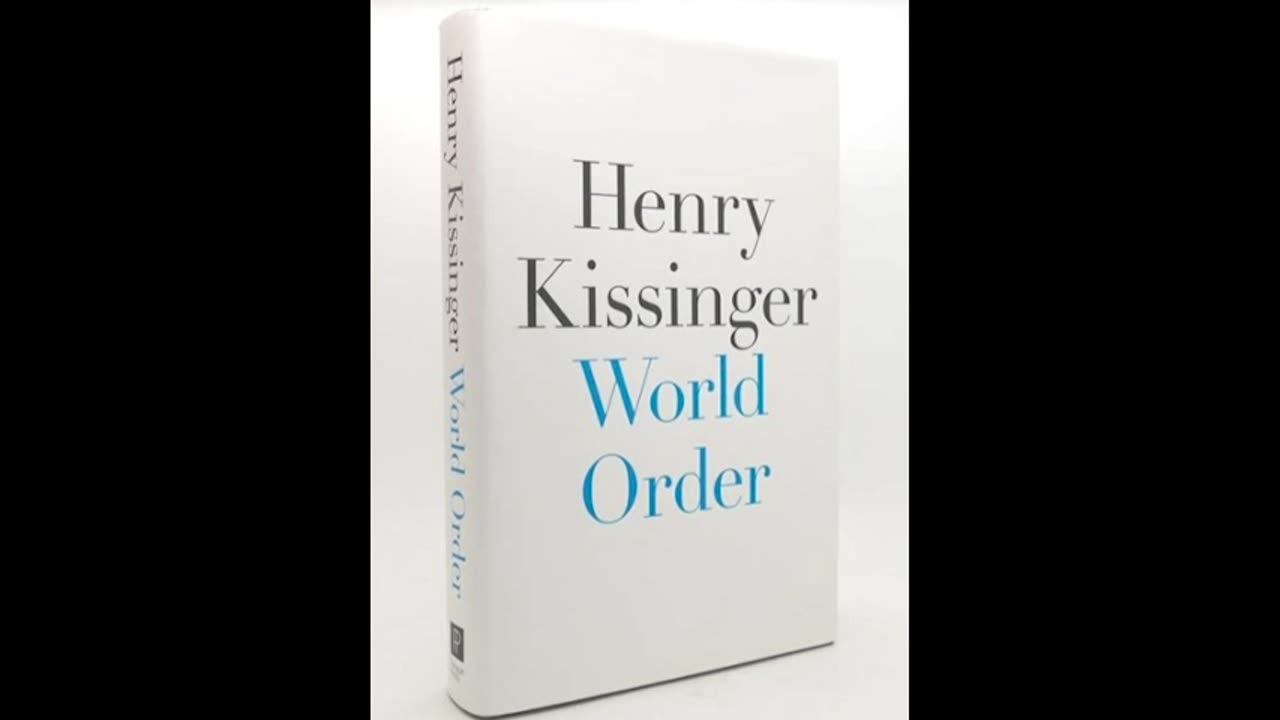
World Order by: Henry Kissinger
This book is a wide-ranging reflection on how stability among nations has been pursued throughout history and why genuine global harmony has remained elusive. Drawing on a lifetime spent at the center of international affairs as scholar, National Security Advisor, Secretary of State, and presidential adviser, Kissinger examines what he sees as the central problem of the modern era: creating a cooperative international system in a world shaped by conflicting traditions, rapid technological change, ideological radicalism, and recurring violence.
Kissinger argues that a single, universally accepted world order has never truly existed. Instead, different civilizations developed their own understandings of how the world should be organized, each believing its approach to be natural and universally valid. He describes how imperial China viewed itself as the cultural core of a hierarchical global system, how ancient Rome imagined a civilized center surrounded by outsiders, and how post-Roman Europe gradually built the idea of independent sovereign states balanced against one another. He also explores how early Islamic civilization regarded itself as the only legitimate political community, with a mission to extend its principles outward, and how the United States emerged with the belief that democratic values could and should be applied everywhere.
In the contemporary era, these historically distinct visions now intersect on a truly global stage. Decisions made in one region immediately affect every other, and major powers are constantly engaged with one another. Yet, according to Kissinger, there is no shared agreement about the basic rules that should govern this interconnected system or about where it is ultimately headed. The absence of such consensus, he suggests, is a major source of modern tension and instability.
The book combines historical analysis with firsthand accounts from Kissinger’s own diplomatic career. He guides readers through pivotal moments of recent decades, including internal discussions during the Nixon administration’s effort to end the Vietnam War, the dramatic negotiations between Ronald Reagan and Soviet leader Mikhail Gorbachev in Reykjavík, and the complex evolution of relations between the United States and China. Kissinger also assesses the development of the European Union and reflects on the difficult lessons of conflicts in Iraq and Afghanistan. His narrative extends to more recent challenges, such as nuclear negotiations with Iran, Western reactions to the Arab Spring, and the confrontation between Russia and the West over Ukraine.
By linking these modern events to centuries of historical experience, Kissinger presents World Order as both a study of the past and a warning about the future. He contends that the twenty-first century will require new forms of statesmanship capable of reconciling different traditions and interests within a common framework. The book ultimately serves as an attempt by one of the most influential diplomats of the modern age to explain how a fractured world might still find a path toward balance and cooperation.
About the Author:
Henry Kissinger was one of the most influential figures in American foreign policy during the second half of the twentieth century. Born in Germany in 1923 and immigrating to the United States as a teenager, he later became a scholar of international relations at Harvard University, where his work on diplomacy and strategy gained wide recognition. His academic career established him as a leading thinker on the balance of power, statecraft, and the historical foundations of global politics.
Kissinger entered public service at the highest level in 1969 when he was appointed National Security Advisor to President Richard Nixon. He later served as Secretary of State under both Nixon and Gerald Ford. During these years he played a central role in major international developments, including the opening of relations with China, negotiations to end the Vietnam War, Middle East diplomacy, and arms control talks with the Soviet Union. For his efforts in negotiating a ceasefire in Vietnam, he was awarded the Nobel Peace Prize in 1973.
After leaving government, Kissinger remained active as an author, consultant, and commentator on world affairs. He wrote numerous books on history, diplomacy, and strategy, and continued to advise presidents and global leaders for decades. Known for his pragmatic approach to international relations and his deep knowledge of history, Kissinger became one of the most recognized voices on questions of war, peace, and global order. World Order reflects the experience and perspective of a statesman who spent a lifetime observing and shaping the course of modern history.
-
 7:17:19
Deus Meum Que Jus
10 days agoThe New World Order -A Recipe for War or Peace! (2015 International Conference, Putrajaya, Malaysia)
5221 -
 LIVE
LIVE
Graham Allen
21 minutes agoIs Trump Running Again?! Candace's Most DISGUSTING Attacks on Erika Kirk Yet! + Minneapolis Updates
7,340 watching -
 LIVE
LIVE
Chad Prather
13 hours agoWalk Worthy: Living What You Believe
5,476 watching -
 LIVE
LIVE
LFA TV
11 hours agoLIVE & BREAKING NEWS! | WEDNESDAY 1/28/26
3,408 watching -

Game On!
15 hours ago $1.70 earnedNFL Super Bowl Props BEST BETS!
15.5K2 -
 1:06:40
Crypto Power Hour
13 hours ago $3.03 earnedCrypto Heist Bombshell: $40+ Million Stolen From Uncle Sam
21.2K1 -
 24:43
24:43
Jasmin Laine
14 hours agoTrump Team CALLS OUT Carney on Fox—Poilievre FACT-CHECKS Liberals Into SILENCE
19.7K18 -
 6:59
6:59
Gun Owners Of America
19 hours agoBBC Reporters Get Schooled On The Second Amendment
12.7K4 -
 29:46
29:46
Brad Owen Poker
23 hours ago $0.84 earnedI Hit QUADS, FULL HOUSES, And FLUSHES! WILD Player Falls For TRAP & OVERBETS HUGE! Poker Vlog Ep 363
13.8K1 -
 LIVE
LIVE
BEK TV
1 day agoTrent Loos in the Morning - 1/28/2026
176 watching