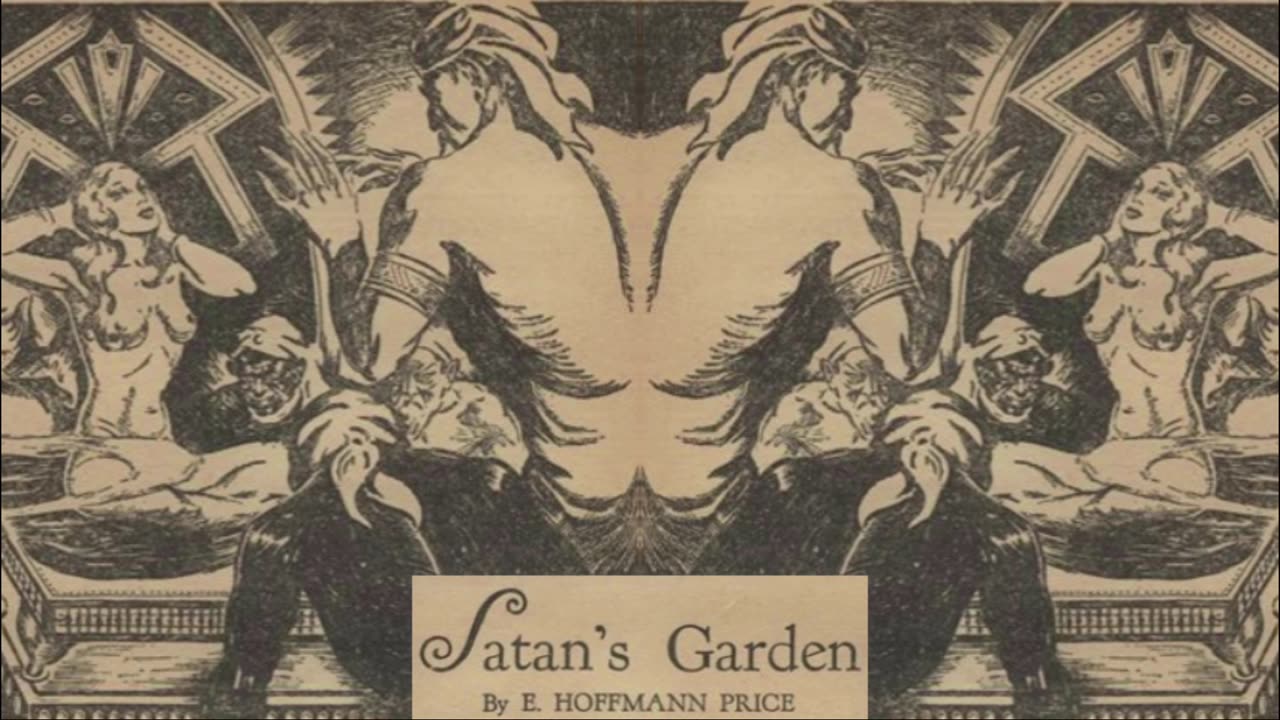
Satan’s Garden by E. Hoffmann Price (1942)
This novel is a work of exotic adventure and occult-tinged intrigue that blends psychological tension with themes of temptation, power, and moral ambiguity. Set largely outside the familiar Western world, the story draws heavily on atmosphere, using foreign landscapes and cultural distance to heighten a sense of danger and moral dislocation. The title signals provocation, but the book is less concerned with literal satanism than with the ways desire, ambition, and corruption flourish when restraint is removed.
Price structures the narrative around characters who are drawn into environments where conventional moral boundaries are weakened. Wealth, sensuality, and influence operate as lures rather than rewards, and the setting itself becomes an active force shaping behavior. The garden of the title functions symbolically as a place of indulgence and testing, where inner weaknesses are exposed rather than imposed from outside.
The horror in the novel is restrained and psychological rather than grotesque. Supernatural suggestion is present, but it is secondary to the examination of human motives and ethical collapse. Price emphasizes consequence over shock, allowing tension to build through implication, atmosphere, and the slow recognition that moral compromise carries an inevitable cost.
Historically, Satan’s Garden reflects a transitional moment in pulp fiction, where adventure, horror, and psychological realism increasingly overlapped. It demonstrates how genre fiction could explore moral decay and personal responsibility without relying on overt monsters or explicit sermons. The novel stands as an example of pulp writing used to examine character under pressure rather than simply deliver sensation.
About the Author:
E. Hoffmann Price (1898-1988) was an American writer known for his wide-ranging work in pulp magazines, particularly in horror, fantasy, and adventure fiction. He was a contemporary and close associate of H. P. Lovecraft and contributed frequently to Weird Tales. Unlike many of his peers, Price often emphasized character psychology and cultural setting as much as plot.
Price had firsthand experience with the regions and cultures he wrote about, which gave his fiction a sense of lived detail uncommon in pulp literature. His work frequently explores themes of temptation, honor, and moral testing, especially in environments where familiar social constraints are absent. Although long overshadowed by more famous contemporaries, his writing is now recognized for its atmospheric control, narrative discipline, and willingness to treat genre fiction as a serious vehicle for examining human behavior.
-
 7:17:19
Deus Meum Que Jus
13 days agoThe New World Order -A Recipe for War or Peace! (2015 International Conference, Putrajaya, Malaysia)
5341 -
 13:56
13:56
Robbi On The Record
1 day ago $2.89 earnedWhy Everyone Is Deleting TikTok (billionaires, control & immigration)
32.9K13 -
 11:35
11:35
Dr. Nick Zyrowski
2 days agoHow To REVERSE Poor Eyesight ( Especially After 40 )
30.6K10 -
 59:06
59:06
The Rubin Report
9 hours agoPlan ₿ Forum El Salvador Day 1 Recap | Dave Rubin
116K7 -
 57:14
57:14
BonginoReport
8 hours agoDon Lemon ARRESTED: Why It Matters More Than You Think - Nightly Scroll w/ Hayley Caronia (Ep.225)
142K111 -
 11:08:58
Plan ₿ Forum
8 days agoPlan ₿ Forum El Salvador 2026 – Day 1 Live from the WAGMI Stage
234K17 -
 2:46:22
Laura Loomer
8 hours agoEP168: STAGED?! Ilhan Omar Uses Fake "Attack" To Cover Up Somali Fraud
69.2K34 -
 3:02:11
Nerdrotic
10 hours ago $8.87 earnedHollywood STRIKES Again?! | Star Trek Crash and Burn | Cancel Disney Plus - Friday Night Tights 391
104K6 -
 1:05:53
Candace Owens
8 hours agoAND ANOTHER ONE: Charlie's Text On September 9th. | Candace Ep 299
108K566 -
 1:47:50
Kim Iversen
9 hours agoDon Lemon ARRESTED: Who Could Be Next?
66.3K145