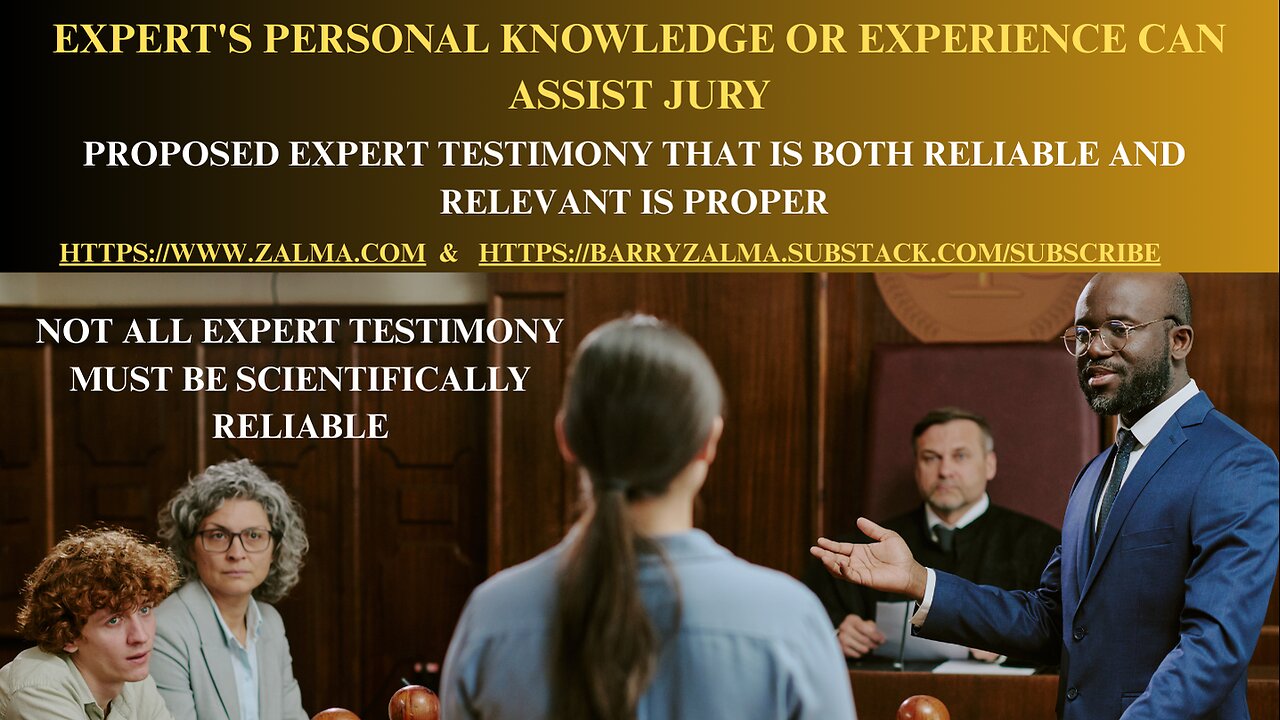
Expert's Personal Knowledge or Experience Can Assist Jury
Proposed Expert Testimony That is Both Reliable and Relevant is Proper
Not All Expert Testimony must be Scientifically Reliable
Post number 5284
See the video at and at https://youtu.be/KsqNjTlx82Y
In Church Mutual Insurance Company, S.I. v. Chabad Of New Mexico, No. 1:24-cv-00090-MIS-SCY, United States District Court, D. New Mexico (February 10, 2026) the USDC dealt with a declaratory judgment filed by Church Mutual that it owes no duty to cover Chabad's claims because the property was “vacant” for more than sixty consecutive days before the acts of arson, and therefore no coverage is owed pursuant to the Policy's “Vacancy” loss condition.
FACTUAL BACKGROUND
Church Mutual Insurance Company, S.I. (“Church Mutual”) renewed an insurance policy for Chabad of New Mexico (“Chabad”) covering real property in Rio Rancho, New Mexico. The policy included a “Vacancy” loss condition, stating that if the building was vacant for more than 60 consecutive days prior to a loss, Church Mutual would not pay for losses caused by certain events, including vandalism.
The claims adjuster assigned to investigate the fires stated that “while the building was not actively being used, there remained sufficient contents in the structure for the Insured to continue their normal operations."
The interpretation and construction of an insurance policy is a question of law for the Court and one that the Court performed when it ruled on the Parties' cross-motions for summary judgment on the issue of coverage concluding that Chabad's building was not “vacant” under the unambiguous terms of the Policy and that therefore Chabad was entitled to summary judgment on the issue of coverage as to both fires. As such, the Court finds that this argument was moot.
Chabad sought to introduce expert testimony regarding insurance industry standards, customs and practices and about how Church Mutual Insurance Company deviated from those standards in its handling of the property damage claims of” Chabad. Chabad hired Stuart Setcavage who purports to be “an expert in the field of insurance industry claim handling, policy interpretation and coverage analysis."
As to the Vacancy provision, Mr. Setcavage states: "Claim professionals are trained to know that the vacancy condition of the building combines suspension of coverage for certain perils with reduction in coverage for others . . . The approach . . . eliminates coverage only for the perils most affected by vacancy, and it reduces coverage for damage by other perils. ”
Church Mutual sought to exclude the expert testimony of S. Setcavage.
ANALYSIS/DISCUSSION:
The Court denied Church Mutual’s Corrected Motion to Exclude the testimony of S. Setcavage. The judge found that the motion did not warrant exclusion and permitted the testimony to be presented at trial.
Mr. Setcavage noted that “neither the perils of arson nor fire are specifically identified” in the Vacancy provision, and opines that “the intent of the policy was to reduce coverage by 15% for perils not specifically listed, not eliminate it altogether.” Mr. Setcavage further opined that Church Mutual is attempting to redefine ‘vacancy' to include factors not set forth in the policy. Church Mutual now wants vacant to mean unused.
District courts evaluating the reliability of non-scientific expert testimony do not have to focus on whether the expert employed an objective standard or methodology and can instead focus on the reliability of the expert's personal knowledge or experience.
Here, Mr. Setcavage has offered opinions that may assist the jury in deciding whether Church Mutual has engaged in bad faith insurance conduct. In fact, the claim handling or investigation is indicia of a pre-determination to deny payment for these claims. The Court was satisfied that Mr. Setcavage's proposed expert testimony was both reliable and relevant, in that it will assist the trier of fact.
Church Mutual Insurance Company's Corrected Motion to Exclude the Testimony of S. Setcavage, was denied.
ZALMA OPINION
Insurance claims handling expert witnesses are not scientists, do not deal with scientific or engineering realities but rather are presented to explain to a jury that actions of an insurer in dealing with a claim, were conducted within the custom and practice of the insurance industry and whether the insurer fulfilled or failed to fulfill the standards of the industry. For that reason, since the court had ruled that the insurer's attempt to apply a vacancy condition to apply to perils not identified the court concluded the expert would help the jury understand whether the tort of bad faith was involved.
(c) 2026 Barry Zalma & ClaimSchool, Inc.
Please tell your friends and colleagues about this blog and the videos and let them subscribe to the blog and the videos.
Subscribe to my substack at https://barryzalma.substack.com/subscribe
Go to X @bzalma; Go to Barry Zalma videos at Rumble.com at https://rumble.com/account/content?type=all; Go to Barry Zalma on YouTube- https://www.youtube.com/channel/UCysiZklEtxZsSF9DfC0Expg; Go to the InsuranceClaims Library – https://lnkd.in/gwEYk.
-
 8:14
8:14
Insurance Law
6 days agoTo Be Insured You Must be Named and Live in House
24 -
 27:43
27:43
marcushouse
1 day ago $10.71 earnedSpaceX’s Starship Strategy Just Changed… Big Time!
23.8K20 -
 29:35
29:35
Connor Tomlinson
1 day agoRupert Lowe Rescues Britain's Crown From the Gutter
18.9K17 -
 31:33
31:33
Squaring The Circle, A Randall Carlson Podcast
1 day ago#078 This Man Made "Grand Canyon" Is A Warning: Providence Canyon
30.2K6 -
 2:57
2:57
scoutthedoggie
1 day agoAirsoft Hospital Battle Scotland PT2
18.7K1 -
 1:33
1:33
Damon Imani
1 day agoI Tested Defending Cardi B's "Jump ICE" Warning...
19.9K6 -
 31:50
31:50
Brad Owen Poker
1 day ago $0.85 earnedABSOLUTELY CRUSHING Vanessa Selbst!!! New ALL TIME Biggest Win!! 25/50/100 NL! Poker Vlog Ep 211
13.3K1 -
 1:05
1:05
Memology 101
1 day ago $2.52 earnedThis is f*cking SICKENING...
31.2K29 -
 15:01:47
Ashaelon
16 hours ago $1.26 earnedThe Roundtable of Randomness - Ep-0005
20.3K9 -
 LIVE
LIVE
TheSchleppy
21 hours ago $0.55 earned✨#FREETheSchleppy✨ROMEO IS DEAD & JULIET IS A WHORE, I THINK???
71 watching