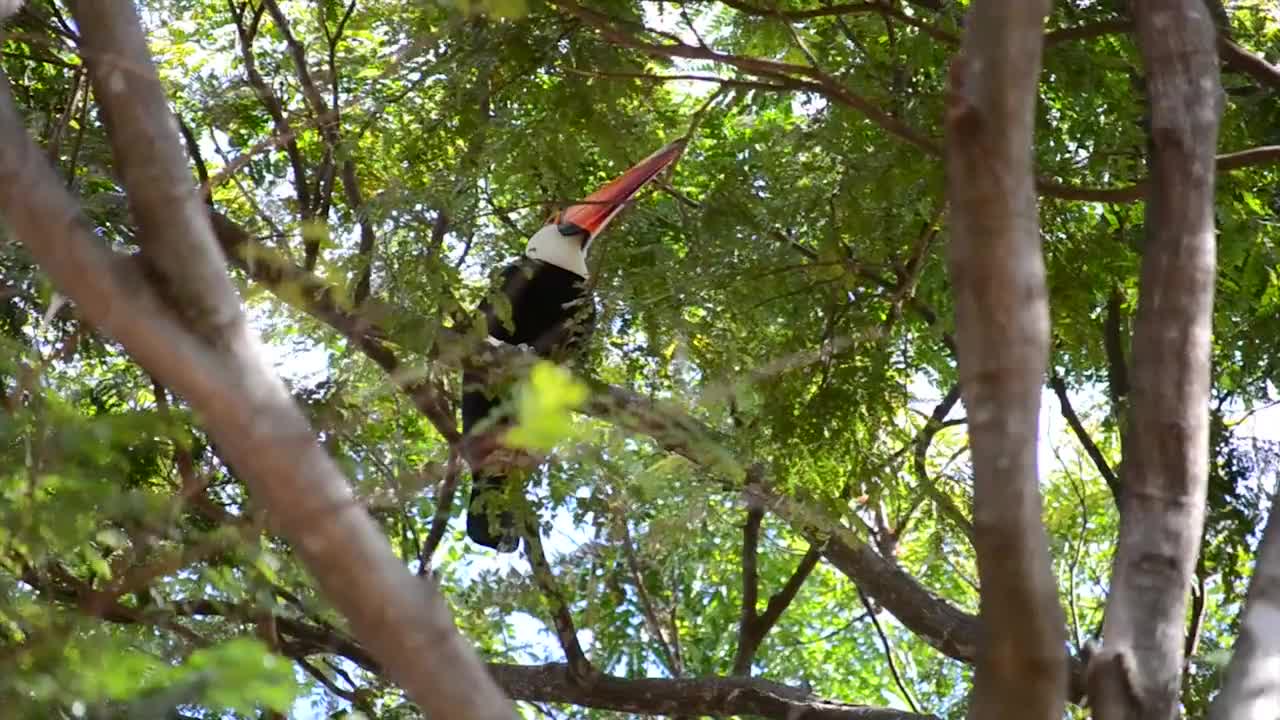
Brazilian Tucano Bird Spotted On Tree Branch
In feeding, the toucan obtains food with the saw-edged bill and must toss back its head before swallowing. Although toucans are often considered to be primarily fruit eaters, most species consume a wide variety of food, including insects, snakes, frogs, and occasionally even small mammals. Toucans are also predators on the contents of songbird nests, consuming both eggs and nestlings. In foraging, toucans form large associations of two or more species that search for fruiting trees.
Measuring 63.5 cm (25 in.) in length, the toco toucan is the largest of all toucans. Its black body and white throat are overshadowed by its most recognizable trait: a large colorful beak.
The bright orange beak is about 19 cm (8 in.) long – one third of the bird’s total length. But despite its substantial size, the beak weighs less than you may think. Composed of the protein keratin, the structure of beak incorporates many air pockets allowing for a very low mass.
Furthermore, recent research has concluded that toucans regulate body temperature by adjusting the flow of blood to their beak. More blood flow means more heat is released. When toucans sleep, they tuck their beak under their feathers to keep them warm.
Toco toucans also use their beaks to pluck and peel fruit, their main source of food. In addition, the beak houses a flat tongue of the same length, which helps the toucan catch insects, frogs, and reptiles. Toco toucans also occasionally eat the eggs of other birds.
Although they spend a lot of time in trees, they are not very good at flying. Toucans mainly travel among trees by hopping. When they do take flight, they flap their wings vigorously and glide, traveling only short distances.
Toucans nest in the hollows of trees. They often move into cavities created and abandoned by woodpeckers.
Several toucans live together in a single hollow. It is in these hollows that they lay their eggs, generally two to four a year. Both parents incubate the eggs for 16-20 days. Once the chicks hatch, both parents continue to care for the young. Baby toucans are not born with an excessively large beak; the beak grows as the birds develop.
Native to South America, toco toucans inhabit a range of habitats including tropical forests, savannas, and shrubland.
-
 LIVE
LIVE
Glenn Greenwald
2 hours agoHillary Blames TikTok for Anti-Israel Sentiment; MAGA Sycophants Gain Pentagon Press Access; Who Should Win Anti-Semite of the Year? See the Top 10 Finalists | SYSTEM UPDATE #552
5,018 watching -
 1:03:17
BonginoReport
3 hours agoViolent Criminals Run Free in NY & CA - Nightly Scroll w/ Hayley Caronia (Ep.188) - 12/02/2025
81.7K19 -
 41:54
41:54
Katie Miller Pod
4 hours ago $2.24 earnedPete & Jen Hegseth on Family Values, Job Transition, & Military Readiness | KMP Ep. 17
8.86K7 -
 1:04:57
The Nick DiPaolo Show Channel
4 hours agoHegseth “War Criminal” My Ass | The Nick Di Paolo Show #1824
14K34 -
 59:47
59:47
TheCrucible
5 hours agoThe Extravaganza! EP: 68 with guest co-host Rob Noerr (12/02/25)
84.8K6 -
 1:20:19
Kim Iversen
4 hours agoHegseth Throws Admiral Bradely Overboard | Kash Patel's Bomber Jacket Tantrum
18.3K47 -
 LIVE
LIVE
LFA TV
22 hours agoLIVE & BREAKING NEWS! | TUESDAY 12/02/25
905 watching -
 LIVE
LIVE
The Bold Lib
1 hour agoBOLDCHAT: Trump Accounts | Venezuela | Somalia w/ANGELA BELCAMINO
84 watching -
 23:01
23:01
Jasmin Laine
4 hours agoCTV Catches Carney LYING!—Poilievre Drops a NUCLEAR Fact-Check
4.34K14 -
 1:29:39
Redacted News
4 hours agoWar Alert! CIA Caught Inside Venezuela Trying to Kill Maduro, Russia Captures 86 cities since Sept
123K147