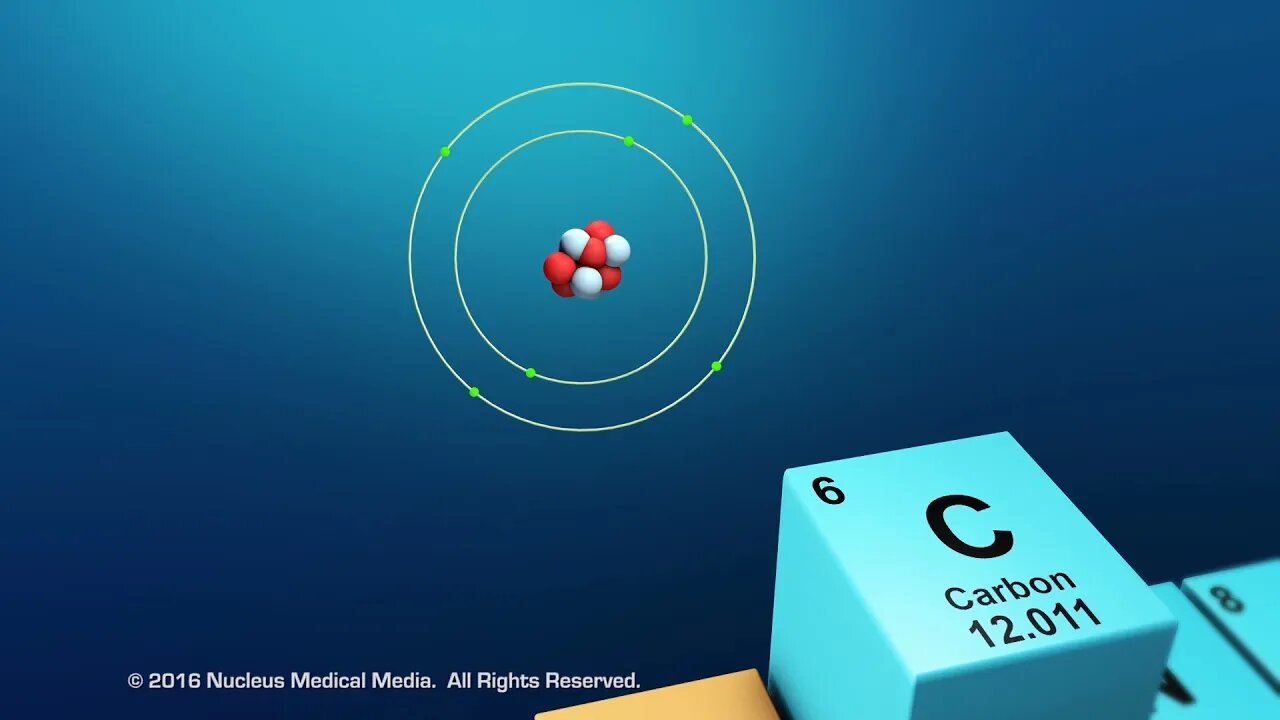
Overview of Organic Compounds
For Employees of hospitals, schools, universities and libraries: download up to 8 FREE medical animations from Nucleus by signing up for a free trial at: http://nmal.nucleusmedicalmedia.com/biology_youtube
#OrganicCompounds #OrganicMonemers #polymers
SCIENCE ANIMATION TRANSCRIPT: Today, we are going to be talking about organic compounds. Organic compounds are studied in biology because they are found in all living things. All organic compounds have the element carbon in them. In other words, all living organisms contain carbon. What's so special about the element, carbon? For one thing, no other element matches carbon's unique versatility to bond with other elements. Let's look at why this is true. For starters, carbon has an atomic number of six. That means that every atom of carbon has six protons in the nucleus. As an electrically neutral atom, carbon also has six electrons. Two core electrons are in the first energy level, which means it has four remaining valence electrons in the second energy level. Remember, valence electrons are those electrons available for bonding with other atoms. Accompanying these four electrons are four bonding sites, or four places that carbon can form bonds with other carbon atoms, or with atoms of other elements. Carbon's four valence electrons and four bonding sites allow it to form strong covalent bonds with many other elements, including hydrogen, oxygen, nitrogen, and phosphorus. Another feature of carbon atoms is they often form covalent bonds with other carbon atoms, to a nearly unlimited degree. This means that two carbon atoms can bond to one another, 50 carbon atoms can bond to one another, or even hundreds of carbon atoms can bond to one another. The ability of carbon atoms to bond to one another gives it the unique ability to shorten or lengthen a chain of carbon atoms to meet the very demands of the chemistry of life. So what kinds of molecules can carbon form? Well, small organic molecules called monomers are chemically bonded atoms that always include carbon. In addition to carbon, organic monomers usually contain hydrogen and oxygen, possibly along with nitrogen or phosphorus. Organic monomers often chemically bond to each other, joining together like beads on a string. This string of attached monomers will often continue to chemically bond with additional monomers, creating a much larger molecule, called a polymer. This process is called polymerization. Polymers may be made of different monomers or repeating units of the same monomer. Many organic polymers in the cells of living organisms are such large molecules that they're often referred to as macromolecules. DNA is an example of a macromolecule. Macro molecules can contain hundreds or even thousands of atoms. The four types of organic macromolecules are carbohydrates, lipids, proteins, and nucleic acids. Although they are all very large molecules, each type of organic macromolecule is distinct and different from the others. We'll discuss these four types of macromolecules in more detail separately. To sum up, organic compounds are found in all living things. All organic compounds contain the element carbon. Carbon atoms have a unique ability to bond to other carbon atoms, as well as other elements, such as hydrogen, oxygen, nitrogen, and phosphorus. Organic monomers are chemically bonded atoms that always include carbon. Polymerization is the process of creating long molecules, called polymers, from multiple bonded monomers. And macromolecules are very large organic molecules. [music]
NSV16027
-
 55:11
55:11
Sarah Westall
22 hours agoHumanity Unchained: The Awakening of the Divine Feminine & Masculine w/ Dr. Brianna Ladapo
5.25K3 -
 1:42:41
Glenn Greenwald
6 hours agoReaction to Trump's Primetime Speech; Coldplay "Adultery" Couple Reappears for More Shame; Australia and the UK Obey Israel's Censorship Demands | SYSTEM UPDATE #560
95.1K54 -
 2:46:41
Barry Cunningham
4 hours agoBREAKING NEWS: President Trump Signs The National Defense Authorization Act | More News!
17.4K18 -
 43:10
43:10
Donald Trump Jr.
6 hours agoThe Days of Destructive DEI are Over, Plus Full News Coverage! | TRIGGERED Ep.301
89.8K61 -
 52:07
52:07
BonginoReport
5 hours agoThe Internet Picks Bongino’s FBI Replacement - Nightly Scroll w/ Hayley Caronia (Ep.200)
81.3K58 -
 55:30
55:30
Russell Brand
7 hours agoStay Free LIVE from AmFest — Turning Point USA - SF665
116K14 -
 1:11:26
Kim Iversen
8 hours agoTrump Pulls War Fake-Out…Attack on Venezuela Still Coming!?
75.7K101 -
 2:04:53
Redacted News
6 hours agoPutin just changed EVERYTHING with this move and NATO can't do anything | Redacted w Clayton Morris
168K133 -
 25:22
25:22
DeVory Darkins
6 hours agoTrump scores MAJOR WIN after Inflation Report as his speech sparks EPIC MELTDOWN
53.2K56 -
 1:01:23
Nick Freitas
7 hours agoLIVE at America Fest!
68.5K3