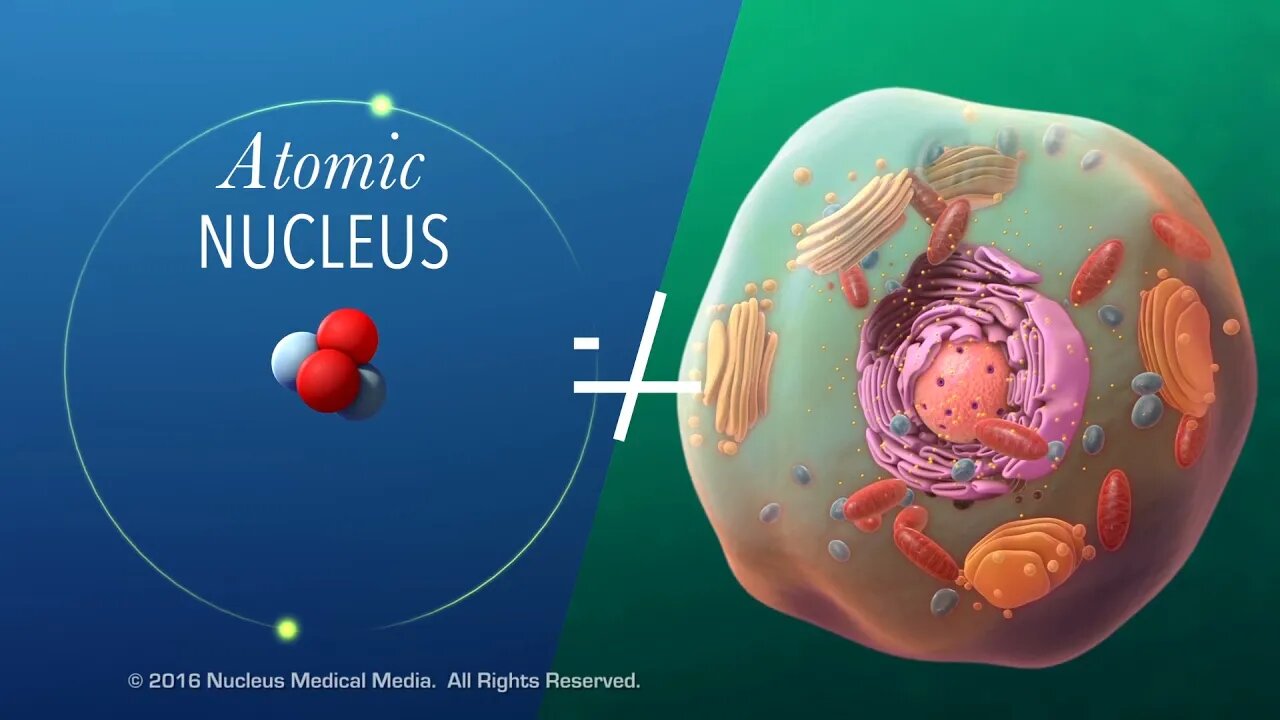
Atoms
For Employees of hospitals, schools, universities and libraries: download up to 8 FREE medical animations from Nucleus by signing up for a free trial at: http://nmal.nucleusmedicalmedia.com/biology_youtube
#atoms #chemistry #biology
SCIENCE ANIMATION TRANSCRIPT: In this video, we'll discuss what atoms are. The chemistry of life begins with understanding the properties of matter. Of course, matter is everything that has mass and takes up space. It includes both nonliving things as well as all living organisms. And atoms are the basic units of all matter, both living and nonliving. They're so small that you could fit billions of them on the head of a pin. But what are atoms made of? First, let's look at the inner central region called the nucleus. Nucleus means center. However, the atomic nucleus isn't the same thing as the nucleus in a cell. A cell's nucleus is its control center, containing instructions that control cell functions. An atomic nucleus is made up of one or more subatomic particles called protons and neutrons. If the nucleus has only one particle, it must be a proton. Each proton and neutron has an atomic mass unit of one. Together, these nuclear particles contain virtually the entire mass of an atom, but they take up less than 1% of the volume. In addition to mass, some subatomic particles also have an electrical charge. A proton carries a positive charge of plus one. As its name indicates, a neutron is electrically neutral, which means it has no charge. Outside the nucleus are subatomic particles called electrons. While electrons contribute almost nothing to the mass of an atom, each of them carries a negative electrical charge of minus one. And even though electrons are always outside the nucleus, they're found in layers called energy levels, or shells, around the nucleus. Each electron shell or energy level has a maximum number of electrons it can hold. For simplicity, diagrams of atoms often show electrons within these shells while orbiting the nucleus. However, since we can only know the probability of where they might be located, electrons are sometimes depicted as smeared out and fuzzy. This fuzzy view of electrons is called an electron cloud. Notice that neutral atoms contain equal numbers of protons and electrons. This means that the positive charge of the protons balances out the negative charge of the electrons, making the atom electrically neutral. In summary, an atom has three main subatomic particles: protons and neutrons in the nucleus, and electrons in shells outside the nucleus. The sum of the protons and neutrons in the nucleus makes up almost the entire mass of the atom. Protons have a positive electrical charge. Electrons have a negative electrical charge, and neutrons have no charge at all. Electrically neutral atoms have an equal number of protons and electrons. [music]
NSV15010
-
 1:47:00
Redacted News
5 hours agoBOMBSHELL! NATO'S WORST NIGHTMARE IS ABOUT TO COME TRUE & CONGRESSMAN MASSIE JUST WENT ALL IN
142K190 -
 35:33
35:33
Stephen Gardner
5 hours agoThe Supreme Court Just Changed History FOREVER!
51.4K72 -
 12:26
12:26
The Gun Collective
2 hours agoDid Glock Copy Itself? NEW GUNS JUST RELEASED!
6.59K4 -
 13:09:11
LFA TV
22 hours agoLIVE & BREAKING NEWS! | WEDNESDAY 12/10/25
205K29 -
 LIVE
LIVE
TheSaltyCracker
1 hour agoPodcaster Civil War ReeEStream 12-10-25
12,008 watching -
 1:16:31
Kim Iversen
4 hours agoTucker: Egyptian Planes Trailed Erika Kirk for Years
37.6K72 -
 LIVE
LIVE
Mally_Mouse
1 day ago🎮 Let's Play!!: Stardew Valley pt. 36
136 watching -
 DVR
DVR
Quite Frankly
7 hours agoENDING Income Tax, Rejected Amendments, Reels & OPEN LINES | KrisAnne Hall 12/10/25
13.1K10 -
 55:09
55:09
American Thought Leaders
4 hours agoA Neurosurgeon’s Proof of an Immortal Soul | Dr. Michael Egnor
14.5K6 -
 2:05:09
The Mike Schwartz Show
5 hours agoTHE MIKE SCHWARTZ SHOW Evening Edition 12-10-2025
9.47K3